Chapter 2 of How AI Is Changing Existing Industries
Two of the world’s most ambitious AI labs are now preparing to step onto the same public stage that SpaceX has just dominated. Before SpaceX, we have never seen a trillion-dollar IPO. In the wake of a record-breaking and successful IPO that raised $75B at $1.75B valuation for SpaceX, OpenAI and Anthropic have quietly filed their S‑1s, inviting public markets to judge not only their financials but their competing visions for how AI should be built, governed and sold.
One has spent the past three years turning ChatGPT into the default interface for intelligence, raising unprecedented sums to own the chips and data-centers behind it; the other has carved out a reputation as the more disciplined engine of enterprise AI, growing on the back of APIs, coding agents and strict usage controls. Their filings will force a question that the SpaceX IPO only hinted at: In an AI economy defined by scarce compute and abundant potential, which business model looks like a platform for the future?
Why This Matters Now
Still remember the craze around OpenClaw (subsequently acquired by OpenAI) at the beginning of 2026? It was the first time the broader industry saw, in public, what an AI agent could look like in production. 2026 will likely be remembered as the inception year for agents: the moment we stopped treating LLMs as chatbots and started treating them as wild, powerful “horses” that needed a serious harness and a well-designed loop to do real work.
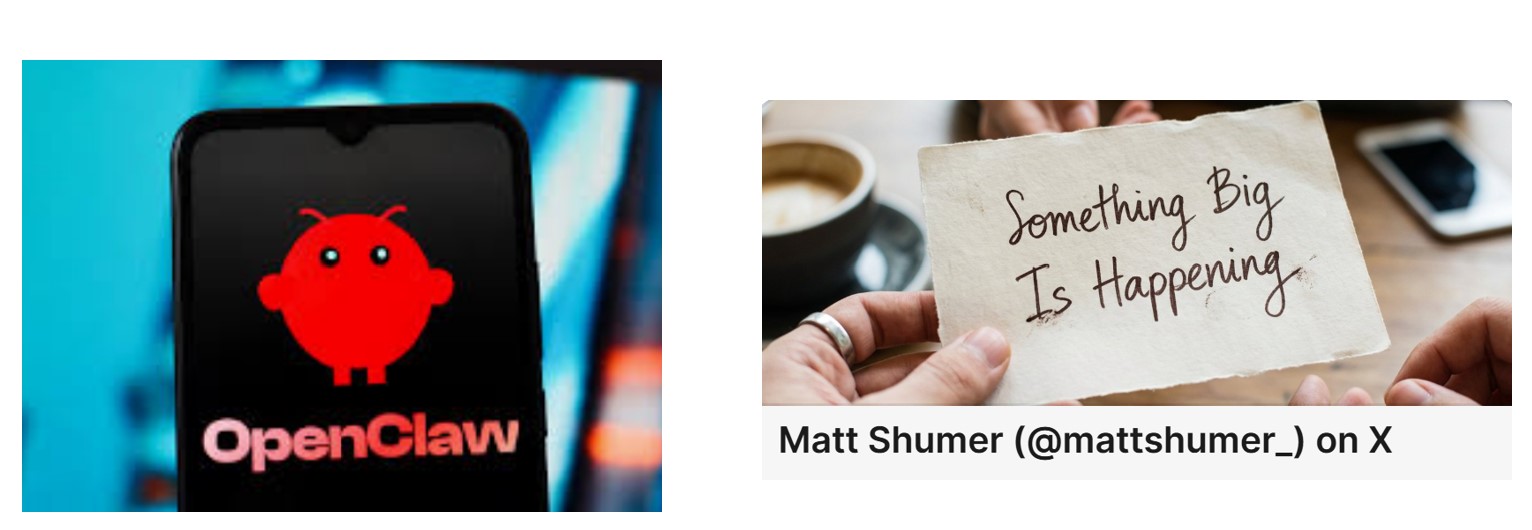
That shift in mindset framed everything that followed. In the first half of 2026, we saw the exceptional success of Claude Code in the enterprise market and the meteoric rise in annualized revenue of Anthropic from ~$9B at the end of 2025 to the tune of $47B by late May. Then on 1 July, Palantir CEO Alex Karp blasted frontier AI labs for what he called an “effing insane” business model that forces enterprises to pay ever‑rising token bills while risking their proprietary data and IP. He argued that companies are effectively paying a “wealth tax” that transfers their competitive “alpha” to third parties, and tied the critique to Palantir’s “AI sovereignty” manifesto, which attacks “tokenmaxxing” and urges institutions to keep control of their data, model weights, and strategic edge. Eight days later, Palo Alto Networks CEO Nikesh Arora weighed in. His tone was measured, but his numbers were stark: he told CNBC that AI token prices need to drop by as much as 90% before enterprise adoption can truly scale. Arora joins a growing chorus of executives — with Karp the loudest among them — warning about runaway token costs and “bill shock,” and arguing that it is already pushing corporate buyers toward cheaper open‑weight alternatives, including Chinese models that are rapidly narrowing the capability gap with the leading proprietary AI labs.
We have posited in last year’s newsletter that open source does not kill proprietary and vice versa. Over the course of the past year, we have seen US frontier AI labs converging into a duopoly with Anthropic and OpenAI taking the lion’s share of the market measured by revenues (each making tens of billions of dollars in ARR by early 2026). In China, the field is still wide open. The AI labs that currently aggressively market their open-weight models to capture global market share, such as Zhipu, MiniMax and Moonshot, report one to two hundred million dollars in ARR each. However, it is worth noting that they all gate their most powerful flagship models behind closed-source APIs, the same way as their larger peers Bytedance and Alibaba do. This makes sense because laggy models can be given for free but leading models are usually kept proprietary. We also note that the race is no longer about LLMs, but the production ecosystem around it. Models are not enough. Without a harness, an LLM is just raw capability, hard to steer and hard to trust. The hard problem is engineering the harness well and turning it into a reusable, standard pattern – and that’s exactly what the whole industry is still trying to figure out. Full-stack Agent = Model + Harness + Loop. The model provides raw intelligence and decision-making, the harness wrapped it in tools, context, rules, permissions, and memory, and the loop layer let humans set goals, guardrails, and acceptance criteria while the agent drove each step (e.g., the goal concept in Claude Code or Codex). For the first time, we are not just prompting a model—we are delegating workflows to an agentic system that could see our apps and data, act inside them, and manage state over time. Private evals, skills, good agent harnesses are critical USPs and moats in this new phase of the AI race.
OpenAI: Here comes GPT-5.6
Earlier this week, OpenAI released GPT-5.6 (with its family of models Sol, Terra and Luna). In our view, this is not a single upgrade, but a strategic move that fits the context discussed above.
First, the family of models cover everything from flagship to lightweight, all simultaneously available on ChatGPT, Codex, and the API. Along with the release of GPT-5.6, OpenAI also introduced three new features:
- ChatGPT Work – positioned as “work OS”, an automation assistant designed for enterprise teams, with the ability to work across multiple software applications including email (Outlook, Gmail), calendar (Google contacts/Microsoft 365), Slack & Teams, cloud storage and docs (Google Drive, Notion, etc), and CRM (HubSpot, Salesforce, etc).
- Codex integrated into the ChatGPT – the previously standalone coding tool is now fully integrated into the new ChatGPT desktop version and hence chat, office assistant, and code development can be accessed through a unified platform, eliminating the need to switch applications.
- Multi-Agent Orchestration + Programmatic Tool Calling – allows models to write and run lightweight programs in memory, autonomously coordinate tools, and process intermediate results, making them more efficient.
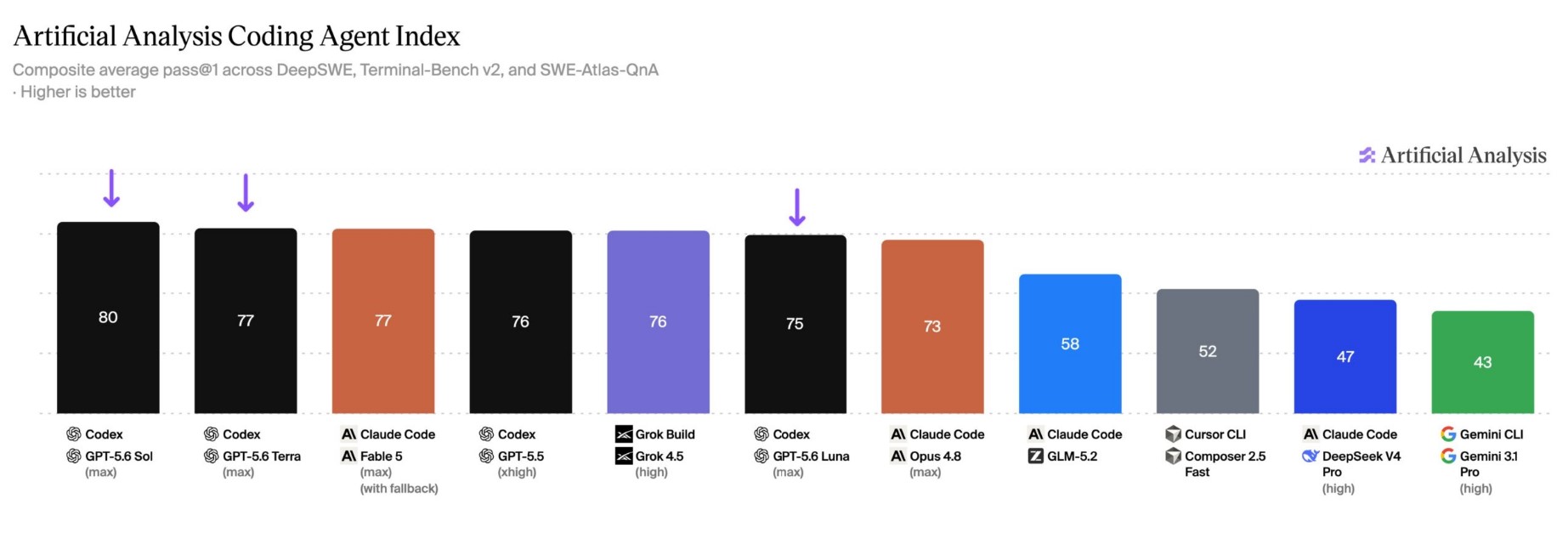
Second, the top‑tier Sol model delivers explosive performance while costing roughly one‑third as much. On the widely followed third-party evaluation platform Artificial Analysis’s coding agent index, GPT-5.6 Sol scored 80 points whilst Anthropic’s strongest model Claude Fable 5 scored 77.2 points. GPT‑5.6 Sol completes coding runs in less than half the execution time of Claude Fable 5, while using less than half the number of output tokens and costing roughly 1/3 as much. GPT-5.6 Sol on Cerebras can reach 750 tokens/sec inference speed and early reports suggest its latency advantage may be helped by highly optimized infrastructure as well.
Third, previously OpenAI’s pricing model was mainly subscription-based. With the latest release, OpenAI has adopted a more nuanced pricing model. The models are largely API-based and priced very competitively even against some open-sourced ones, while it links Codex (agent harness) to engineering outcomes instead of mere usage, giving OpenAI more room to justify premium pricing.
GPT-5.6 Sol (The Sun) — The most powerful model to date
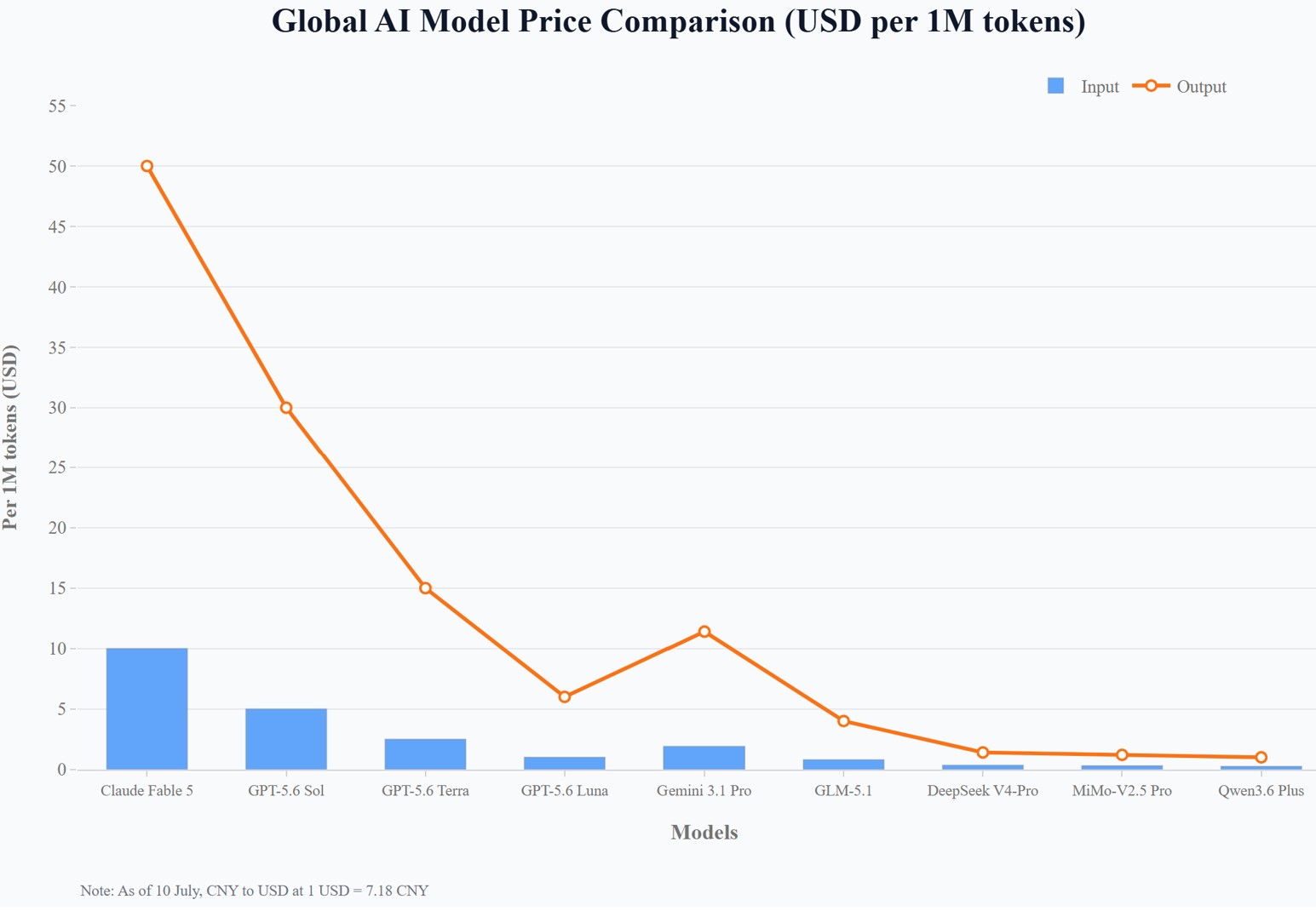
Designed for the most complex reasoning, high-intensity code development, scientific research, cybersecurity, and long-running agent tasks. This is OpenAI’s most powerful model to date, priced the same as GPT-5.5, but offers a significant performance leap. Input/Output cost of $5/30 per 1M tokens.
GPT-5.6 Terra – Balanced Value for Money
Suitable for the vast majority of everyday workloads. Performance is comparable to the previous generation GPT-5.5, but the price is halved, making it very practical. Input/Output cost of $2.5/15 per 1M tokens.
GPT-5.6 Luna (Moon) – Lightweight Speed Model
It features low latency and high frequency of calls, and has the lowest cost among the three, making it suitable for scenarios with extremely high requirements for response speed. Input/Output cost of $1/6 per 1M tokens. It is priced comparable to GLM5.1 by Z.Ai (Zhipu).
The chart below summarizes the API token pricing of global AI companies, including the open-sourced models from Chinese companies (Z.Ai, Deepseek, Xiaomi and Alibaba).
The Bigger Bet Behind GPT-5.6
Taken together, GPT‑5.6 feels less like a routine model refresh and more like OpenAI re‑asserting itself on the eve of going public: Performance at or above the frontier on most tasks, delivered at a fraction of the cost, wrapped in an integrated bundle that fits everyday workflows for both consumers and enterprises. In our next blog, we’ll turn from technology to strategy and unpack how the business models of the two leading frontier labs are starting to diverge.