Chapter 3 of How AI Is Changing Existing Industries
In the Gen AI era, a single year feels like an entire generation. While the broader verdict is out, our goal for readers is clear: to spot the trends and emerging fault lines early and examine the players through the lens of global dynamics and industry/consumer behaviors, not just production launches or hype cycles. From a strategic perspective, both OpenAI and Anthropic are taking different high-risk bets: Anthropic on being the premium engine inside the world’s workflows, OpenAI on owning the doors and interface to AI from work to play and back it up with compute. The two leading frontier AI labs are charging their own courses and exposed to different fault lines.
OpenAI – Compute, enterprise acceleration, and owning the front-door to AI
OpenAI’s recent moves suggest a company trying to tackle three intertwined priorities at once: secure enough compute, accelerate enterprise deployment, and owning the front-door to AI. The unprecedented March 2026 capital raise of $122bn and the self-designed AI chips help with the first problem; Codex and other workflow products address the second; and ChatGPT’s massive reach coupled with Jony Vie partnership and investments into leading robotics companies underpin the third.
Securing enough compute
For leading labs, securing compute is now existential: without enough hardware, product roadmaps stall and revenue caps out. Whilst many enterprise customers of Claude report caps on monthly usage and per‑user limits for high‑end models, with stricter throttling on long‑context workloads and bulk batch jobs due to Anthropic’s own compute constraint and dependence on external clouds, OpenAI is trying to turn control of scarce compute into a long‑term strategic moat.
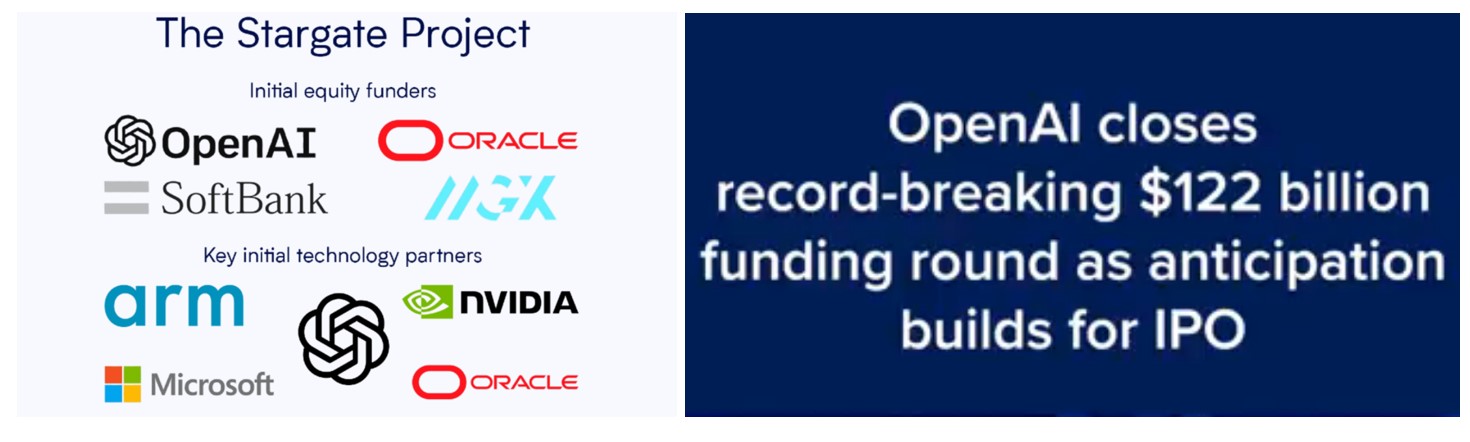
The $122bn raise in March and Stargate build‑out are meant to break that constraint by locking in multi‑year datacenter and power capacity, while the “Jalapeño” inference chips designed in-house and built by Broadcom push down serving costs and tighten control over economics. Sarah Friar, OpenAI’s CFO, has described the moves as creating strategic leverage over infrastructure. If Stargate and other datacenter bets succeed, the company could become the backbone on which a wide range of AI products, agents and even some rivals’ services ultimately run.
Accelerate enterprise development
Enterprise autonomous coding didn’t start with Cursor, but Cursor is the first AI‑native coding agent that made “let the AI ship it” the default and that’s what blew the category open. In 2023, Cursor launched its AI-native editor and then hit key milestones at extraordinary speed: crossing $100M ARR within roughly 14–17 months and reaching about $1B in ARR by late 2025, with adoption by more than half of the Fortune 500. By early 2026 it was widely described as the fastest‑growing developer tool in history, having scaled to roughly $2B ARR and solidified its position as the leading AI coding environment.
Its success was initially intertwined with Anthropic, which supplied Claude models. Cursor reportedly accounted for a significant share of Anthropic’s ARR before the relationship began to cool in 2025 and Anthropic pushed its own Claude Code product more aggressively starting May 2025. Since then, Claude Code has surged in adoption, contributing to Claude’s broader meteoric rise as a default choice for developer workflows. As Anthropic’s revenue model is heavily API-based, programmatic usage (Claude models in code, agents, SDKs) via pay-per-token APIs accounts for 70–75% of its revenues.
By early 2026, as Anthropic surpassed OpenAI’s global share in the enterprise AI market, both OpenAI and SpaceX (which had subsumed xAI) took notice.
SpaceX secured a structured call option to buy Cursor for $60B and subsequently closed the deal shortly after its mega IPO in June. With ample compute and an in‑house frontier AI lab (xAI), the addition of Cursor gives SpaceX a ready‑made distribution channel into the developer world and a mature agentic interface for turning its models into practical coding tools, effectively plugging xAI’s ecosystem straight into the workflows of thousands of engineering teams.
OpenAI’s counter to Anthropic’s “Claude Code + API” story is to make Codex feel less like a single coding product and more like the spine of an AI‑native work stack. Codex has gone from effectively zero usage in 2025 to over 5 million weekly active users by early June 2026, rivalling Claude Code despite launching later, and it has done so by moving beyond the pure developer persona faster. OpenAI says knowledge workers now make up roughly 20 per cent of Codex users and are growing more than three times as fast as developers, suggesting the product is escaping the traditional coding‑assistant category and becoming a broader work‑automation surface. If that trajectory continues, its edge may lie less in having the “best coding agent” and more in quietly turning coding into just one module inside a larger AI work platform. Economically, that shift matters: a coding assistant sold only to engineers is valuable, but a work agent used by finance, sales, operations, research and technical teams supports a much larger seat base and richer, workflow‑linked pricing. Codex’s non‑developer uptake is therefore not just headline growth, but a signal that OpenAI may be aiming at a higher‑ceiling market than coding alone.
OpenAI is also experimenting with how it charges. A March 2026 report (citing The Information) notes that OpenAI had surpassed $25 billion in ARR in early 2026. As noted by many analysts, OpenAI reports ARR based on net revenues whereas Anthropic reports ARRs in gross terms before hyperscalers take their revenue cuts so they are not directly comparable. Where Anthropic has focused on API‑metered pricing (pay-per-token), OpenAI has historically relied more on subscriptions (unmetered or loosely capped), but that is now shifting. Its latest flagship models, GPT‑5.6 Sol and Terra, are being positioned primarily on API‑based pricing, while Codex adds layers of seat, team and workflow‑based charges over raw token use. This links Codex to engineering outcomes instead of mere usage, giving OpenAI more room to justify premium pricing even as they cut model API rates.
Strategically, OpenAI is building Codex as an infrastructure for software delivery. With the latest release on 9 July, Codex is now fully integrated into the new ChatGPT desktop version. In a world where the battleground may shift from “whose agent feels better in the terminal” to “whose platform quietly orchestrates how engineering work gets done,” that breadth could potentially make Codex easier to weave into complex corporate workflows. For enterprise clients that are sensitive to employee adoption and ROI on AI spent – a case that CEOs at Palantir and Palo Alto Networks have both started to make – branding and ease of use are important parts of the decision.
Owning the front-door to AI
Whoever controls the primary interface for AI — the place people instinctively go to ask questions, make plans, and delegate work — has disproportionate power over the ecosystem. Search engine giant Google enjoyed that position for the web; OpenAI wants ChatGPT and its suite of products to enjoy it for AI.
In 2022, ChatGPT became the first product to reach 100 million users globally within just a month of launch. Last year, it was Apple’s most downloaded iPhone app in the U.S. Today, OpenAI’s share of consumer mindshare remains far ahead of rival labs, with 900 million weekly active users of ChatGPT. As described by its CFO, Sarah Friar, the company maintains a keen interest in the consumer market. In a recent interview, she said “If I was optimizing only for today, I would give every token to the API…But that’s not the game we’re playing. Our strategy is to be an AI infrastructure layer that serves consumers, small businesses, large enterprises, and governments”.
Whatever devices Jony Ive eventually ships or owning the “brains” in humanoid bodies and industrial robots is owning a new class of front door. It is an attempt to turn AI from something you open in a computer into an ambient, physical presence, and create product surfaces that can capture more of the value chain.
Does OpenAI’s strategy make sense?
The approach is logical if you believe that AI will become the primary way humans interact with information and work, that the biggest prizes go to whoever owns that interaction layer, and that new device and robot categories will emerge around AI. The risk is not that the strategy lacks vision, but that it may be trying to win too many games at once and each of those is hard and capital‑intensive. Anthropic is betting that being the model and API layer is enough; OpenAI is betting that only by owning the front door to AI and securing the compute to power it can it truly justify the scale of its ambition and infrastructure. If even one of the new front doors — the AI‑powered work OS, the Jony Ive device, or the robotics tie‑ups — becomes canonical, OpenAI’s strategy will look prescient.
Anthropic – To be the default AI engine inside the enterprise
Anthropic has gone from being “a frontier lab” to a central pillar of the Gen AI landscape over the past year. Its Claude family, with Claude Fable 5 at the top end, has become known for strong reasoning, safer behavior, and more reliable long‑context work than many of its peers, until at least the release of GPT5.6. That combination has played well with large institutions that were wary of handing critical workflows to systems perceived as more experimental or less predictable. Data from ETR, CNBC, and independent market analyses all point to Anthropic’s revenue and adoption being overwhelmingly enterprise‑driven (around 80% of revenue with rapidly rising penetration), with Claude Code playing a central role in that growth.
As Gen AI moved from pilots to production, boards and CIOs started caring less about leaderboard bragging rights and more about whether an AI partner looked and behaved like an enterprise‑grade vendor; Anthropic leaned hard into that positioning. Rather than selling “a chatbot that can code,” Anthropic framed Claude Code as an agentic harness around its models: a way to plug Claude models into engineering workflows with guardrails, tooling, and observability. Over the past year, Claude Code has become a default choice in many large organizations for things like code review, refactoring, test generation, and migration projects, not just ad‑hoc snippet generation. In other words, Anthropic’s success has been less about “Claude vs X model on capabilities” and more about winning the production ecosystem: an enterprise‑grade stack centered on agentic harnesses, models, and skills that turns a frontier AI lab into a durable, enterprise‑first business.
However, the salvos from CEOs of Palantir and Palo Alto Networks are not unwarranted, despite strategic theatre in what they are saying, as they have pointed out the key pain points of enterprise clients: cost curves, data control, and long‑term bargaining power. These are early public markers of the friction that will shape the next phase of the AI enterprise market in our view. Is Anthropic’s enterprise-first engine strategy automatically safer or more rational than OpenAI’s front-door bet?
Here we look at four angles:
1. Dependence on enterprise and API-only economics a strength but also a vulnerability
Because ~80% of revenue is tied to API and enterprise contracts, Anthropic is exposed to procurement cycles and budget cuts. That by itself may not be a concern in the near term, but overtime enterprises will need to justify the ROI on AI spent.
In addition, Many CTO/CIOs view “single-provider dependence” as a risk and are actively building multi-model stacks. If enterprise buyers normalize a multi-vendor baseline to avoid dependency (especially after the Fable 5 shutdown incident) or negotiate hard on price, Anthropic’s pricing power and premium positioning could erode faster than its current growth curve suggests. In that sense, Anthropic’s moat is not guaranteed.
2. Rising competition on pricing with comparable performance for everyday tasks
Today, Fable 5 + Claude Code is the go-to choice for many developers on complex projects with fussy/undefined specs due to exceptional reasoning and clarity. But everyday tasks and workflows for non-developers that require strong reasoning do not necessarily need Fable 5 capabilities. Even on the coding side, Anthropic is already facing price competition on API pricing from OpenAI (Codex/GPT5.6) and SpaceX (Cursor/Grok 4.5). Notably, this week, Zuckerberg broke a three‑year silence on X to personally announce Meta’s new agentic coding model, Muse Spark 1.1, and its aggressively low pricing. The pricing made the intent unmistakable: Meta set Muse Spark 1.1 at about $1.25 per 1M input tokens and $4.25 per 1M output tokens. If parts of coding, office automation, and back-office workflows become a price-sensitive commodity, Anthropic’s premium, safety-branded positioning may be squeezed from below.
3. Branding and “golden cage” risks
Anthropic has positioned itself as the premium, ad-free, safety-upheld alternative to OpenAI — including Super Bowl campaigns mocking ChatGPT’s move into ads for free-tier users. That stance brings real brand upside, but it also creates structural constraints: by treating “no ads, high safety” as a core pillar, Anthropic has effectively shut off a major revenue stream that OpenAI and others can tap on the consumer side. History suggests that free or subsidized, ad supported products often dominate mass consumer markets; by opting out of that dynamic, Anthropic may end up ceding mainstream reach even more decisively to OpenAI, Google, and Meta. This trade off is perfectly fine if enterprise demand keeps compounding at today’s pace. It becomes more dangerous if growth normalizes and consumer/SMB segments regain strategic importance. Anthropic could find itself in a kind of golden cage built from its own brand promise, finding it hard to pivot toward ad supported models without undercutting the safety narrative that now defines it.
4. Capital intensity and dependence on hyperscalers
Anthropic’s strategy deliberately pushes capex off its own balance sheet by leaning on Google Cloud, Amazon and other vendors (such as SpaceX) for compute, but that outsourcing of infrastructure is a double‑edged sword. While it reduces upfront infrastructure risk and capex, it makes Anthropic dependent on hyperscaler pricing, capacity, and strategic favor. If Google or AWS or SpaceX decide to favor their own models more aggressively, or to squeeze margins on hosted partners, Anthropic’s cost base and gross margins could deteriorate. The asset light strategy helps lift margins, but the company is not immune to hyper‑scale bargaining power or energy and chip price shocks.
How we view the positioning and strategic choices of these two companies
| Dimension | OpenAI | Anthropic |
| Core ambition | Be the default AI destination | Be the default AI engine inside the enterprise |
| Strategic bet | Own the interface, then expand into tools, agents, and enterprise software | Own the workflow layer by embedding Claude into business systems and developer stacks |
| Ecosystem model | More vertically integrated and eco-system play: product, brand, models, and infrastructure | More partner-led: models, APIs, integrations, and cloud distribution |
| Consumer strength | Category-defining consumer brand, with 900 million active weekly users of ChatGPT | Limited consumer presence |
| Enterprise strength | Moving into enterprise from a consumer-led base | Enterprise-first from the start |
| Revenue model | Revenues shifting towards a hybrid model, seat/work/outcome-based pricing (Codex) + metered API (e.g., GPT‑5.6) + tiered subscriptions (e.g., consumer) | Revenues driven by metered API (across Claude Code, Agent SDK, and third‑party integrations) |
| Compute strategy | More aggressive about securing and building large-scale compute | More asset-light and partner-dependent on infrastructure |
| Developer strategy | Use models, APIs, and coding tools to pull developers into the OpenAI stack | Win developers through Claude, coding performance, and enterprise-friendly tooling |
| Agent strategy | Build agents around ChatGPT as the control layer for digital work | Build agents inside enterprise workflows with reliability and guardrails |
| Physical AI / device strategy | Explicit push into AI-native terminals and devices via the Jony Ive partnership, with OpenAI describing a “new family of companion devices” and bringing deep design leadership in-house | No comparable consumer device push visible today; the strategy remains centered on software, APIs, and embedding Claude inside third-party products and enterprise environments |
| Humanoid robot strategy | Launched a dedicated robotics division; views robotics as part of its broader “physical AI” stack. Investments in/partnerships with Figure AI, 1X Technologies, and Physical Intelligence | No major proprietary humanoid-robot program; its role in physical AI appears more indirect |
| AI Infra strategy | More vertically integrated and diversified: Nvidia remains core, but OpenAI is expanding to AMD, Cerebras, and Broadcom, including its custom “Jalapeño” inference chip with Broadcom | More partner-centric: Anthropic relies on Google TPUs, Amazon infrastructure, and Nvidia, while exploring custom silicon with Samsung as a longer-term option |
| Safety as strategy | Important, but balanced against speed and scale | Central to the brand and enterprise pitch |
Overlapping shareholders
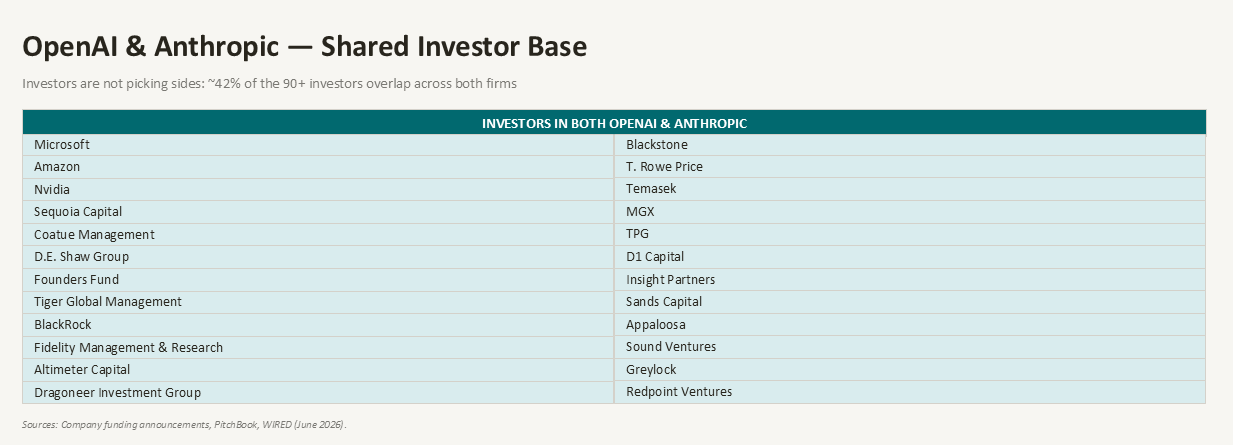
Interestingly, many top institutional investors and strategic operators are seen as backing both horses, as shown in the summary below.
Two IPOs, Two Bets on the Future of AI
Zoom out, and these two public listings amount to a real-world test of two different visions of how AI value gets captured. OpenAI is betting that owning the interface, the compute, and eventually the physical hardware people use to access AI will let it capture value across consumer, enterprise, and device markets at once, even if that means carrying more capital intensity and more competitive fronts. Anthropic is betting that staying focused, leaning on hyperscaler partners for compute, and being the most trusted engine inside enterprise workflows is a narrower but more capital-efficient path to durable margins. Neither bet is obviously right: OpenAI’s breadth could become its moat or its overextension, and Anthropic’s discipline could become its edge or its ceiling. What is clear is that GPT-5.6 has narrowed the performance and pricing gap that used to separate the two labs, so the coming quarters will be judged less on model benchmarks and more on execution: who converts compute into margin, who converts usage into pricing power, and who converts today’s enterprise trust or consumer reach into a business public investors are willing to underwrite for the next decade. For investors weighing these two companies as they go public, that is the real question behind the numbers.